

A systems-based approach to understanding challenging student behavior in schools
For years, student behavior has been approached through a simple lens:
If a student misbehaves, they need a consequence.
This mindset shows up in phrases like:
And while accountability matters, this approach often assumes that behavior is purely a matter of choice.
But in real classrooms, behavior is rarely that simple.
Instead of asking, “How do we get students to comply?” a more powerful question is:
What is making it hard for this student to succeed right now?
Because behavior is not just about rules.
It’s influenced by:
When those conditions are unstable, behavior often reflects that instability.
This is where the shift begins.
Students do not operate in isolation. Every classroom sends signals.
Some environments communicate:
Others unintentionally communicate:
Students respond to those signals every day.
When expectations are unclear, routines change constantly, or responses vary from teacher to teacher, students spend more energy trying to figure out the environment than focusing on learning.
And that often shows up as behavior.
Discipline addresses behavior after it happens.
But it does not:
So the same behaviors tend to repeat.
Not because students aren’t trying, but because the system around them hasn’t changed.
This is why even strong teachers can feel stuck in cycles of:
redirect → consequence → repeat
Without system-level alignment, discipline becomes a loop instead of a solution.
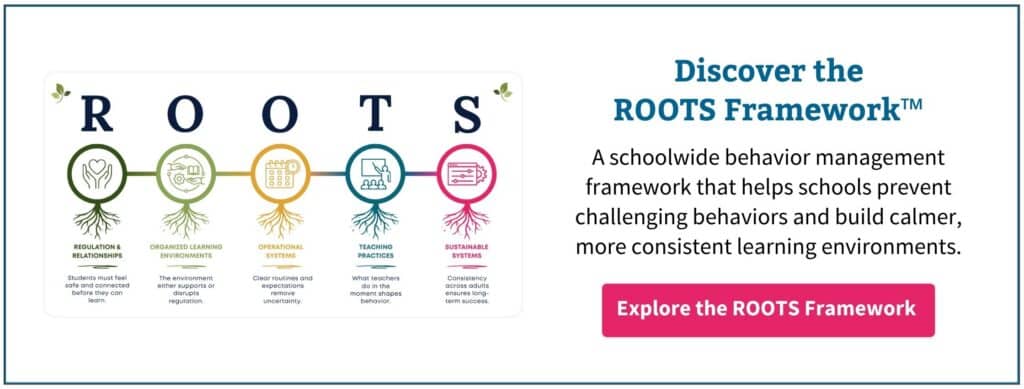
A systems-based approach does not remove responsibility from students.
It expands responsibility across the environment.
It asks:
When schools begin asking these questions, behavior stops being viewed as isolated incidents and starts being understood as patterns influenced by systems.
When schools strengthen systems, several things begin to shift:
✨Students experience more predictability.
✨Teachers spend less time reacting and more time teaching.
✨Expectations feel fair and consistent.
✨Transitions become smoother
✨ Engagement increases
Most importantly, behavior improves not because students are being controlled, but because they are being supported more effectively.
One of the biggest misconceptions about improving behavior is that it requires more programs, more strategies, or more interventions.
In reality, it often requires alignment.
Alignment in:
When schools are aligned, students experience a more stable environment, and that stability reduces behavior challenges naturally.
Instead of seeing behavior as something to fix, schools can begin to see it as something to understand.

Not:
“What consequence does this deserve?”
But:
“What conditions led to this?”
That shift changes everything.
It moves schools from reacting to behavior to designing environments where positive behavior is more likely to happen.
Challenging student behavior is not just about discipline.
It is about the systems students experience every day.
When schools focus only on consequences, they stay in a cycle of reaction. But when they focus on clarity, consistency, and support, they begin to change the conditions that shape behavior in the first place.
And when the system improves, behavior follows.


