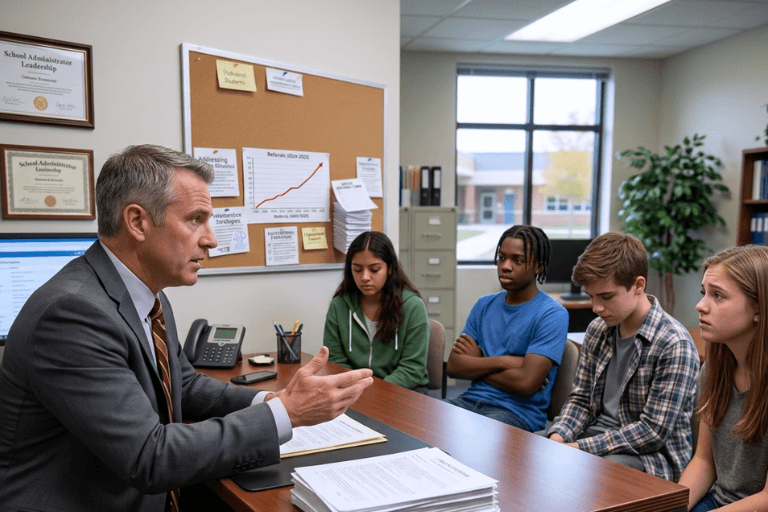

Recently, a principal shared something that stopped me in my tracks:
“Ten years ago, I can hardly remember a kindergarten student being sent to the office. This year, we’ve had multiple kindergarten referrals before the first quarter even ended.”
While every school is different, this story reflects a concern we hear from school leaders across the country.
Office discipline referrals have long been one of the most commonly used measures of student behavior in schools.
They help administrators identify patterns, allocate resources, and determine where support may be needed. But many school leaders are noticing a troubling trend: referrals are increasing, and behavior concerns are appearing at younger ages than educators have experienced in the past.
Kindergarten and elementary teachers report increased challenges with emotional regulation, peer conflict, transitions, frustration tolerance, and impulse control. Secondary educators describe growing concerns around engagement, defiance, disruptive behavior, and student motivation.
The impact extends far beyond the office.
As referrals increase, administrators spend more time managing incidents, teachers feel increasingly overwhelmed, and valuable instructional time is lost. According to the National Center for Education Statistics (NCES), 75% of school leaders reported that student inattention and behavior had a moderate or severe negative impact on learning during the 2023–24 school year.
This raises an important question:
Why are office discipline referrals increasing, and what can schools do about it?
When referral numbers rise, it is easy to focus on the behavior itself.
A student is disruptive.
A student refuses to follow directions.
A student has a conflict with a peer.
A student leaves the classroom.
A student has an emotional outburst.
But office referrals are often not the problem. They are a symptom.
Referrals tell us that something happened. They do not always tell us why it happened.
Every office referral represents more than a behavior incident. It often represents lost instructional time, interrupted learning, and a student who may be struggling to access the support they need.
To truly address behavioral challenges, schools must look beyond individual incidents and examine the conditions that surround them.
Across grade levels, educators are reporting increased concerns about skills that were once taken for granted.
Many students need additional support with:
These skills are essential for success in both learning and behavior.
Just as students require explicit instruction in reading and mathematics, they also benefit from direct teaching, modeling, and practice when it comes to self-regulation and social-emotional skills.
When students lack these skills, behavior challenges often become more frequent.
This does not mean students are unwilling to succeed. More often, it means they need support developing the skills required to navigate increasingly complex academic and social environments.
For principals and assistant principals, rising referral numbers create a ripple effect throughout the entire school.
Time that could be spent coaching teachers, strengthening instruction, building school culture, or supporting staff is instead spent responding to behavior incidents.
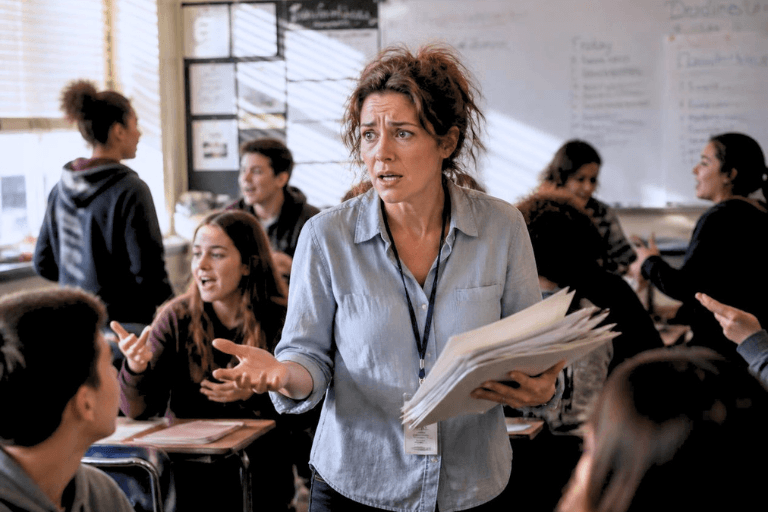
For teachers, repeated disruptions can create frustration, stress, and emotional exhaustion.
For students, frequent referrals often mean missed learning opportunities and reduced connection to the classroom community.
The result is a cycle that affects everyone.
The more behavior incidents occur, the more time schools spend reacting to them.
The less time schools have for prevention, relationship building, and proactive support.
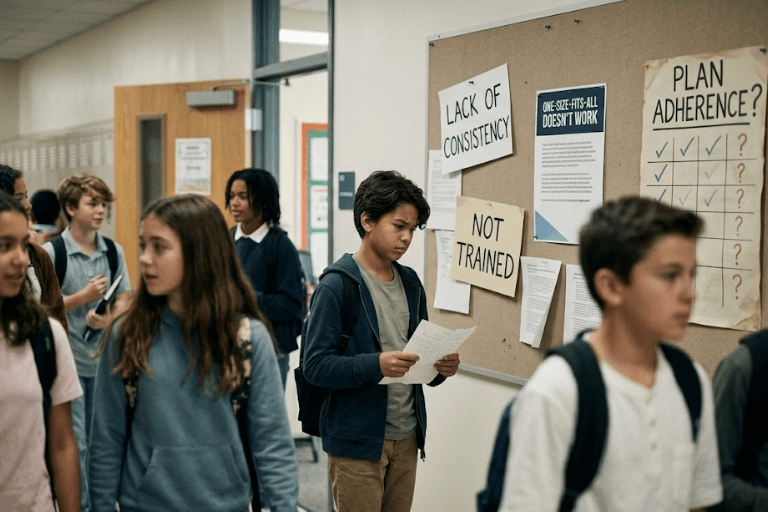
One factor that often contributes to rising office referrals is inconsistency.
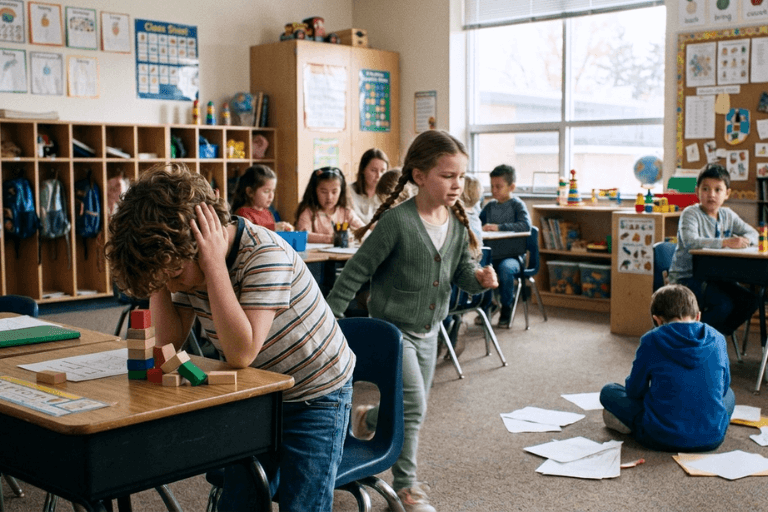
Students move through multiple classrooms, hallways, cafeterias, playgrounds, buses, and common spaces throughout the day.
When expectations differ significantly from one environment to another, students spend valuable energy trying to figure out:
For many students, especially those who struggle with self-regulation, inconsistency creates confusion and stress.
When adults respond differently to the same behavior, students receive mixed messages about expectations and accountability.
Over time, this can directly contribute to increases in behavioral incidents and office referrals.
Many traditional discipline systems focus primarily on consequences.
The assumption is often that if the consequence is significant enough, behavior will improve.
While accountability is important, consequences alone rarely teach replacement skills.
A consequence may temporarily stop a behavior, but it does not automatically teach a student how to regulate emotions, solve problems, communicate effectively, navigate conflict, or make better choices in the future.
This is one reason schools often see the same students repeatedly referred to the office.
The behavior may have been addressed.
The underlying skill deficit may not have been.
If students do not learn the skills needed for success, the behavior is likely to return.
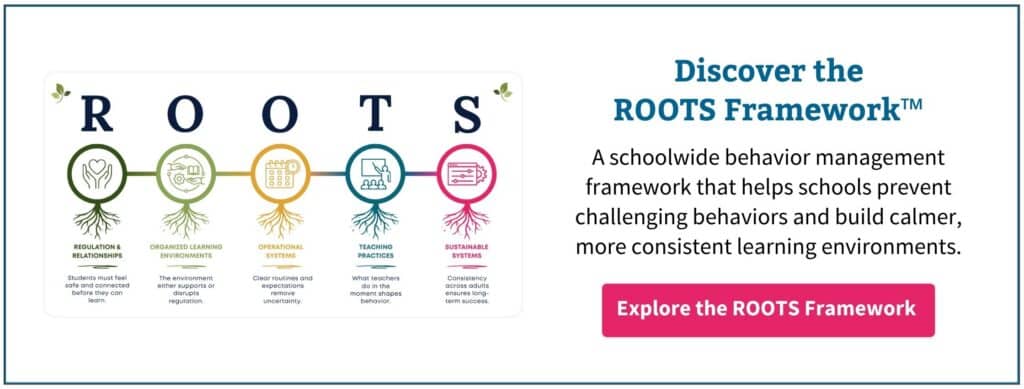
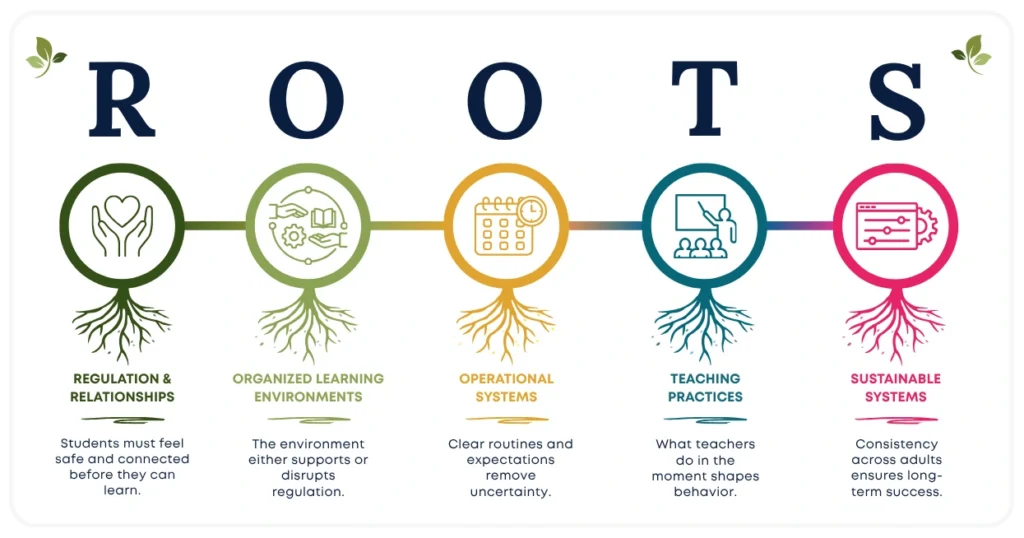
Many school leaders tell us they feel caught between wanting to support students and needing a practical system that teachers can consistently implement. That’s one reason we developed the ROOTS Framework™—a schoolwide behavior management and learning framework designed to help schools move beyond isolated behavior strategies and create consistent systems that support regulation, relationships, instruction, and accountability.
Through onsite training and coaching, schools learn how to reduce office referrals, strengthen classroom management, improve student regulation, and create a more positive and predictable learning environment for both students and staff.
Learn more about the ROOTS Framework and our schoolwide behavior management training programs.
Schools that successfully reduce office discipline referrals tend to shift their focus from reaction to prevention.
Instead of asking:
“How do we respond to this behavior?”
They begin asking:
“What conditions can we create to support positive behavior before challenges occur?”
These schools focus on building:
As consistency increases, behavior challenges often decrease.
Students know what is expected.
Adults know how to respond.
The entire school becomes more predictable and supportive.
The ROOTS Framework™ helps schools move beyond isolated behavior strategies and create consistent systems that support regulation, relationships, instruction, and accountability across every classroom and learning environment.
The goal is not simply to reduce office referrals.
The goal is to create environments where students are more likely to succeed.
When schools invest in prevention, consistency, and regulation, they often see improvements not only in behavior but also in engagement, attendance, school climate, and academic outcomes.
Office referrals become a valuable data point rather than the primary behavior management strategy.
At Strobel Education, years of work in behavior management, PBIS, MTSS, self-regulation, restorative practices, and school improvement led us to an important realization:
No single strategy changes student outcomes on its own.
Lasting change happens when schools create consistent systems that support students across every classroom and every environment.
That belief ultimately led to the creation of the ROOTS Framework™, a schoolwide behavior management and learning framework designed to align expectations, environments, teaching practices, and support systems throughout an entire school.
Rather than focusing solely on interventions or consequences, ROOTS helps schools create the conditions where positive behavior, regulation, and learning can thrive.
Because the most effective way to reduce office discipline referrals is not simply responding to behavior more efficiently.
It is building a system that prevents many behavior challenges from occurring in the first place.
The ROOTS Framework™ helps schools create proactive behavior systems that improve regulation, strengthen classroom management, reduce office referrals, and create more positive learning environments.
Learn more about ROOTS onsite training and coaching.
Schedule a discovery call.
Bring ROOTS to your school or district.