Simple Affirmations for Young Kids You Can Use in the Classroom Daily
Quick, memorable phrases that boost confidence, support emotional regulation, and create a calmer learning environment.
Young children experience big emotions every day, and they are still learning how to understand and manage them. Kids learn emotional regulation by hearing and repeating language that feels safe and supportive.
Affirmations give them supportive language they can return to during moments of stress, frustration, or self-doubt. When used consistently, affirmations strengthen self-esteem, emotional regulation, and resilience, and this can have a long-lasting effect on their lives.
A Dutch study found that children who engaged in effort-focused positive self-talk (e.g., “I will do my very best!”) improved their performance on a math test compared to children who did not use positive self-talk. The benefits were strongest for students with lower confidence in their abilities, suggesting that positive self-talk can boost academic achievement when children focus on effort rather than fixed ability.
Why Affirmations Help Children Thrive
Young learners are constantly forming beliefs about themselves. Short, repeated statements help them practice:
noticing emotions
calming their bodies
building confidence
developing positive self-talk
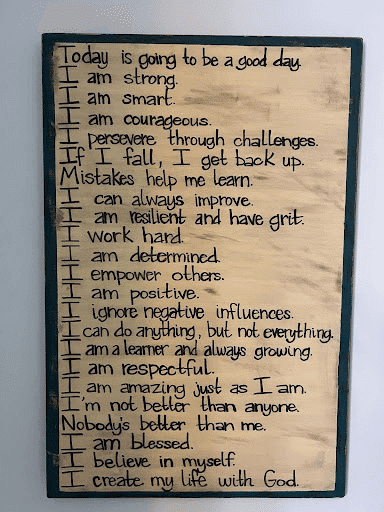
“Affirmations are not just something I teach in classrooms. I use them at home too. This is the affirmation board my son and I used when he was younger, and we repeated these statements every morning before school. Kids rise to the level of the words they repeat, and this simple daily practice helped him build resilience, confidence, and a grounded sense of self. Even now, as a young adult, many of these phrases still guide him through challenges. Affirmations truly stay with children long after they leave our classrooms.
Simple Affirmations Kids Can Remember
Short, rhythmic, and easy for preschool–early elementary students to repeat. Use physical movement you could pair with each one.
Self-Worth & Connection
These affirmations emphasize self-esteem, kindness, and building a positive community. Say these during the morning meeting.
I am kind.
I am respectful.
I can do hard things.
I am smart.
I am strong.
I am a good friend.
My voice is important.
I am loved.
I am proud of myself.
I choose joy.
Growth & Learning Mindset
These affirmations boost persistence, curiosity, and the belief that effort leads to success.
I am learning every day.
I can try again.
I can do hard things.
I can ask for help.
My brain is growing.
It’s okay to make mistakes.
I ask great questions.
Emotional Regulation & Safety
These affirmations help students feel secure and practice techniques for managing their emotions. Say these before transitions or after a chaotic activity.
I can be calm.
I breathe in, I breathe out.
I am safe right here.
I listen.
My feelings matter.
I choose to be patient.
I can handle hard things.
How to Use Affirmations With Children
Affirmations work best when they’re woven into daily routines rather than treated as a one-time lesson.
Morning Meeting: Choose a short list of affirmations for the class to repeat together. You can also introduce an “Affirmation of the Day.” (Growth & Learning Mindset or Self-Worth & Connection)
Calm-Down Corners: Add affirmation cards or posters to your quiet space. Statements from the Emotional Regulation & Safety category work best here to help children settle their bodies and refocus.
Transitions: Instead of countdowns, use one or two quick affirmations from Emotional Regulation & Safety to help students recenter.
After Conflict: Invite a child to choose a calming affirmation to reset. The Emotional Regulation & Safety category offers the most supportive language for restoration.
End-of-Day Reflections: Ask students which affirmation helped them handle a challenge or feel more confident. You can pull from all categories here.
A consistent affirmation routine helps normalize emotions, reduce stress, and build a stronger classroom climate.
When Kids Resist Affirmations
Some children may feel shy or uncomfortable saying positive statements at first. That’s normal. Don’t force participation. Allow them to listen quietly if speaking feels too hard.
Offer gentle alternatives like:
“I am trying.”
“I am learning to calm my body.”
“I can take one small step.”
Affirmations should feel like support, not pressure.
Final Thought
Affirmations are far more than just feel-good phrases; they are tools that fundamentally equip children for life. They give students the language that strengthens emotional awareness, builds confidence, and solidifies a sense of safety within their learning environment. When adults consistently model and reinforce these simple, positive statements, children carry these powerful phrases into challenging moments and, ultimately, into the world beyond the classroom.
For more SEL tools and strategies that help students thrive, explore our Teach Happy resources and SEL Curriculum for Students https://strobeleducation.com/sel-curriculum/ at Strobel Education.
Simple Affirmations for Young Kids You Can Use in the Classroom Daily Individual Pay via PO
Provide us with the information below, and someone from our support team will be in touch within 48 business hours. Once payment is received, you will receive access to the workshop.
Simple Affirmations for Young Kids You Can Use in the Classroom Daily Custom Quote Request
Simple Affirmations for Young Kids You Can Use in the Classroom Daily Custom Quote Request
Place A Bulk Order
For bulk orders of 10 or more copies, we offer a special rate of just $15 per book. To place your bulk order, please fill out the form below with your details and the desired quantity. Our team will respond promptly to finalize your order.