A Schoolwide Behavior Framework That Creates Lasting Change
The ROOTS Framework is a practical schoolwide behavior framework that helps schools improve student behavior, strengthen classroom management, and create consistent systems that support learning.
Schools across the country are facing increasing behavior challenges that impact learning, staff morale, and school culture.
Disruptions are increasing — and teachers are running out of strategies.
Teachers are exhausted from managing behavior instead of teaching.
Office referrals continue to climb — despite everyone trying harder.
The truth is: behavior challenges don’t improve on their own. Schools that see real, lasting change have one thing in common — they stopped reacting and started building systems. Systems that are consistent, schoolwide, and built for the real world.
Move from reactive discipline to proactive systems that work.
What Schools Are Facing Right Now
For students to learn, their brains must be in the right state.
ROOTS creates those conditions.
Staff Responding Inconsistently
Different teachers, different reactions. Students learn to exploit the gaps.
Consequences That Don't Change Behavior
Sending students to the office hasn’t worked. And everyone knows it.
Escalating Classroom Disruptions
Minor situations spiral into major ones before staff can respond.
Student Regulation Breakdowns
Dysregulated students can’t learn — and they make it hard for anyone else to either.
No Shared Behavior Language
Every teacher has their own system. Nothing is schoolwide.
Teacher Burnout from Behavior Management
Staff are spending more energy managing behavior than teaching.
Initiative Fatigue
Staff have seen too many “new programs.” They need something that actually sticks.
THE ROOTS FRAMEWORK
That's Why We Created the ROOTS Framework
With more than 45 years of combined experience in schools, our team has seen the same problem repeated in district after district: schools have well-meaning people, strong values, and a genuine commitment to students — but no unified system that holds it all together.
“Most behavior initiatives focus on isolated strategies instead of the systems that drive behavior across an entire school.”
ROOTS was built to solve that.
Not with another workshop. Not with another binder. But with a framework that changes how every adult in the building thinks, responds, and supports students — together.
THE ROOTS FRAMEWORK
That's Why We Created the ROOTS Framework
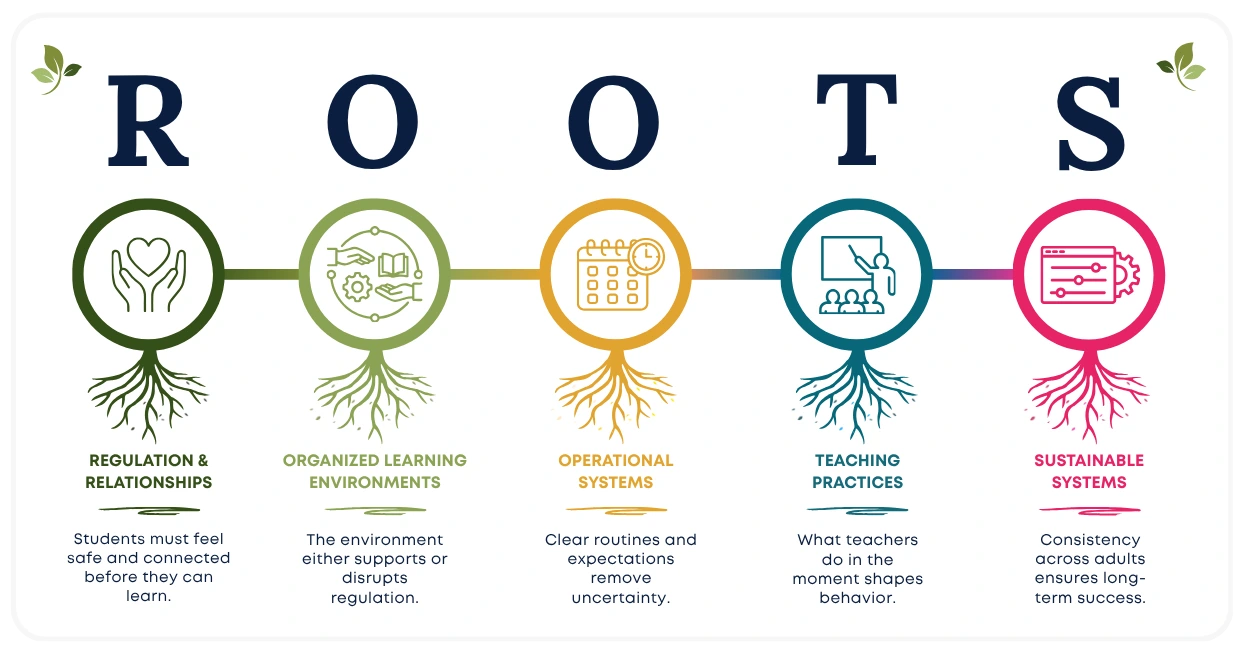
REGULATION & RELATIONSHIPS
Students must feel safe and connected before they can learn.
ORGANIZED LEARNING ENVIRONMENTS
The environment either supports or disrupts regulation.
OPERATIONAL SYSTEMS
Clear routines and expectations remove uncertainty.
TEACHING PRACTICES
What teachers do in the moment shapes behavior.
SUSTAINABLE SYSTEMS
Consistency across adults ensures long-term success.
With more than 45 years of combined experience in schools, our team has seen the same problem repeated in district after district: schools have well-meaning people, strong values, and a genuine commitment to students — but no unified system that holds it all together.
“Most behavior initiatives focus on isolated strategies instead of the systems that drive behavior across an entire school.”
ROOTS was built to solve that.
Not with another workshop. Not with another binder. But with a framework that changes how every adult in the building thinks, responds, and supports students — together.
This Is Not Another Initiative.
ROOTS isn’t a workshop your staff attends and forgets by Friday. It’s a framework that changes how your whole school operates — how teachers respond, how students regulate, how systems support everyone.
One aligned approach. Every classroom. Every hallway. Every adult in the building.
Build a consistent behavior language across every classroom and hallway
Reduce office referrals and classroom disruptions
Support student self-regulation before problems escalate
Reduce teacher burnout from behavior management
Replace reactive discipline with proactive, school-embedded systems
Sustain real change — not just a training memory
Why Schools Choose ROOTS Over Traditional Behavior Training
Most schools already have pieces of the solution.
Trauma-informed practices. Classroom management strategies. SEL initiatives. Restorative practices.
The challenge isn’t a lack of programs.
It’s that the pieces often operate independently.
ROOTS brings them together into one schoolwide behavior framework.
TYPICAL BEHAVIOR TRAINING
Focuses on student behavior
One-day inspiration
Individual classrooms
Reactive strategies
Isolated initiatives
THE ROOTS FRAMEWORK
Focuses on systems that create behavior
Sustainable implementation
Schoolwide alignment
Prevention systems
Integrated framework
What Changes When Schools Implement ROOTS
Schools that implement the ROOTS schoolwide behavior framework often experience:
Fewer Office Referrals
Consistent systems reduce the behaviors that send students to the office — so leaders can lead, not referee.
More Consistent Staff Responses
Everyone speaks the same behavior language — from the gym to the classroom to the front office.
Increased Student Engagement
Regulated students are ready and motivated to learn.
Stronger Teacher Confidence
Staff feel equipped with strategies that actually work in real classrooms, with real kids.
Better Classroom Climate
A regulated, connected environment where students and adults feel safe and supported.
Reduced Educator Stress
Staff spend more time teaching and less time managing escalating behaviors.
Greater Alignment Across Classrooms
Shared systems create consistency that students can count on across the building.
More Instructional Time
Less time on discipline means more time on what matters most — learning.
ROOTS gave our staff a shared language — for the first time, every teacher in the building was responding the same way. Our referrals dropped 40% by the end of the year.
A
Audrey
Principal, Elementary School
I’ve been through a lot of PD. ROOTS is different because it doesn’t just tell you what to do — it builds the systems that make consistent behavior possible every single day.
J
Jonathan
Instructional Coach, K-8 School
Our teachers went from dreading Monday mornings to feeling equipped. ROOTS changed how we see behavior — it’s not a discipline problem. It’s a systems problem.
M
Mary
Assistant Superintendent
"Teachers do not need more theory. They need systems that work in real classrooms."
MEET YOUR ROOTS BEHAVIOR SPECIALIST
Tomelle Greenfield, M.A., ABA
🎓 BCBA Certified🌱 20+ Years in Education🧠 Behavior Specialist🏫 Schoolwide Systems Expert
Tomelle Greenfield developed the ROOTS Framework after two decades inside real classrooms — watching well-meaning schools struggle with the same patterns. She has supported hundreds of educators in building behavior systems that are consistent, compassionate, and sustainable.
When she’s not leading professional development, Tomelle coaches school leadership teams through implementation planning and consults on district-wide behavior strategy.
What Your School Receives
ROOTS Resource Library
OPTION 1
Toolbox / Toolkit Graphic
Lifetime access to behavior matrices, emotional regulation tools, check-in/check-out forms, intervention templates, classroom systems, implementation guides, and ready-to-use resources that help educators put the ROOTS Framework into practice immediately.
OPTION 2
Stack of Branded Resources
Access a comprehensive library of behavior support resources, classroom templates, regulation tools, behavior matrices, and implementation guides that help educators put the ROOTS Framework into practice right away.
OPTION 3
Binder with Tabs
Gain access to a growing library of classroom and schoolwide resources, including behavior matrices, regulation supports, intervention planning tools, check-in forms, reflection activities, and implementation templates that help create consistency across staff and classrooms.
Implementation Workbook Copy
A practical workbook designed to help educators reflect, plan, and apply the ROOTS Framework in their classrooms and schools.
Key takeaways from each framework component
Reflection activities to build understanding and clarity
Action planning tools to support implementation
Resources to sustain progress and drive lasting change
Professional Development
Personal Development Certificate
All participants receive a professional certificate documenting their completed training hours and commitment to student success.
Certificate Copy
All participants will receive a professional development certificate documenting their completed training hours and commitment to student success.
Document your professional growth
Share with your administrator or district
Use for license renewal and PD records
A recognition of your commitment to students
The ROOTS Framework
What Your Team Will Learn
The ROOTS Framework provides educators with a practical roadmap for improving behavior, strengthening relationships, increasing engagement, and creating schoolwide consistency. Each component builds upon the next to help schools create lasting systems that support both students and staff.
Module 1: The Mindset Shift: From Fixing Students to Creating Conditions for Success
The ROOTS Framework shifts the focus from "fixing students" to strengthening the conditions that support behavior, regulation, and learning. Participants will explore how adult responses, classroom systems, and schoolwide practices impact student success while building a shared understanding that behavior is communication and proactive systems create safer, more supportive learning environments.
Module 2: The ROOTS Framework for Behavior and Learning
The ROOTS Framework explores how aligned systems create strong classroom and schoolwide foundations for behavior and learning. This framework focuses on Regulation & Relationships, Organized Learning Environments, Operational Structures, Teaching Practices, and Sustainable Systems to support engagement, regulation, and student success.
Module 3: Understanding the Brain: How Stress, Trauma, and Regulation Impact Learning
Explores how the brain responds to stress, safety, connection, and learning while examining how regulation impacts attention, behavior, decision-making, and engagement.
R Module 4: R – Regulation: Helping Students Regulate, Reset, and Build Capacity
Regulation and co-regulation play a critical role in student success and classroom functioning. Explores strategies that help students recognize, manage, and respond to emotions in safe and productive ways while creating predictable, calming environments.
R Module 5: R – Relationships: Building Connection, Belonging, and Safety
Intentional relationship practices help build trust, belonging, emotional safety, and connection within the classroom community. Explores proactive and restorative strategies that strengthen relationships while increasing student engagement, regulation, and readiness to learn.
O Module 6: O – Organized Learning Environments: Designing Spaces That Support Behavior
Examines how the physical and emotional environment shapes student behavior, regulation, and engagement. Explores how to design classrooms and shared spaces that create structure, predictability, and a sense of safety for all learners.
O Module 7: O – Operational Systems: Building Consistent Routines and Schoolwide Structures
Operational systems provide the structure and consistency students and staff need to function effectively. Explores how clearly defined routines, transitions, and schoolwide procedures reduce uncertainty, prevent behavior challenges, and increase instructional time.
Module 8: Creating Alignment Across Classrooms and Grade Levels
Consistency across classrooms, hallways, and common areas helps students feel safe and understand expectations. Explores how schools can create shared systems that align staff responses and reduce behavioral inconsistencies across settings.
T Module 9: T – Teaching Practices: Proactive Strategies That Prevent Behavior Challenges
Effective teaching practices create the conditions for engagement, regulation, and learning. Explores instructional strategies that increase student participation, reduce behavioral disruptions, and help educators respond to behavior more effectively in real time.
Module 10: High-Leverage Classroom Strategies for Engagement and Behavior
Explores practical, evidence-based strategies that increase engagement, reduce off-task behavior, and create a more productive learning environment. Focuses on proactive approaches educators can implement immediately.
Module 11: Responding to Behavior in the Moment — From Reactive to Responsive
Builds practical skills for de-escalating behavior, maintaining a regulated classroom environment, and responding to challenging situations in ways that protect relationships, preserve dignity, and reduce escalation.
S Module 12: S – Sustainable Systems: Building Structures That Last Beyond the Training Day
Sustainable systems ensure that the practices and strategies learned during ROOTS training continue to support students and staff long after the professional development ends. Explores how schools can build leadership structures, shared language, and implementation plans that drive lasting behavior change.
Module 13: Schoolwide Implementation Planning
Guides school teams through the process of creating a practical, site-specific implementation plan for the ROOTS Framework. Helps leadership teams identify priorities, assign responsibilities, and establish timelines that support consistent, schoolwide adoption.
Module 14: Measuring Progress and Sustaining Momentum
Explores tools and strategies for monitoring implementation fidelity, tracking outcomes, and adjusting practices over time. Helps schools celebrate progress, identify areas for growth, and maintain momentum as they continue to strengthen their schoolwide behavior systems.
ROOTS is not a program or curriculum. It is a framework that provides a common language, shared practices, and aligned systems that help schools create the conditions where students and staff can thrive. Rather than adding another initiative, ROOTS aligns research-based practices into one cohesive approach to behavior, learning, and school culture.
PBIS focuses on teaching and reinforcing positive behavior. ROOTS strengthens PBIS by addressing the relationships, regulation, environments, systems, and teaching practices that influence behavior and learning. ROOTS does not replace PBIS—it helps schools create the conditions that allow PBIS to thrive.
No. ROOTS is designed for all students and all staff. While it supports students experiencing behavioral or emotional challenges, its primary focus is strengthening Tier 1 practices so all students feel safe, connected, engaged, and successful.
Yes. ROOTS incorporates trauma-informed principles such as regulation, relationships, psychological safety, and understanding the impact of stress on behavior. It also goes beyond trauma-informed practices by providing a comprehensive schoolwide framework for behavior and learning.
Absolutely. ROOTS was designed as a schoolwide framework. While individual educators gain practical strategies, the greatest impact occurs when schools implement ROOTS across classrooms, grade levels, and leadership teams.
Implementation timelines vary based on a school’s goals and level of support. Some schools begin using ROOTS strategies immediately, while others engage in a multi-year implementation process that includes professional development, coaching, and leadership support.
Yes. Strobel Education offers coaching and implementation support to help schools move from learning to action. Coaching may include leadership support, classroom observations, implementation planning, and ongoing guidance.
Yes. ROOTS was designed to strengthen and align existing efforts such as PBIS, MTSS, SEL, restorative practices, trauma-informed practices, and classroom management initiatives. It does not replace existing work—it helps schools integrate it more effectively.
Ready to Build a Schoolwide Behavior Framework That Works?
Help your educators move beyond reactive discipline and create lasting behavior change.